
Google's AI can now predict how genetic mutations affect your specific cells
Original headline: Google DeepMind Releases AlphaGenome 2 for Cell-Type-Specific Variant Effects — marktechpost.com
More in AI and machine learning news
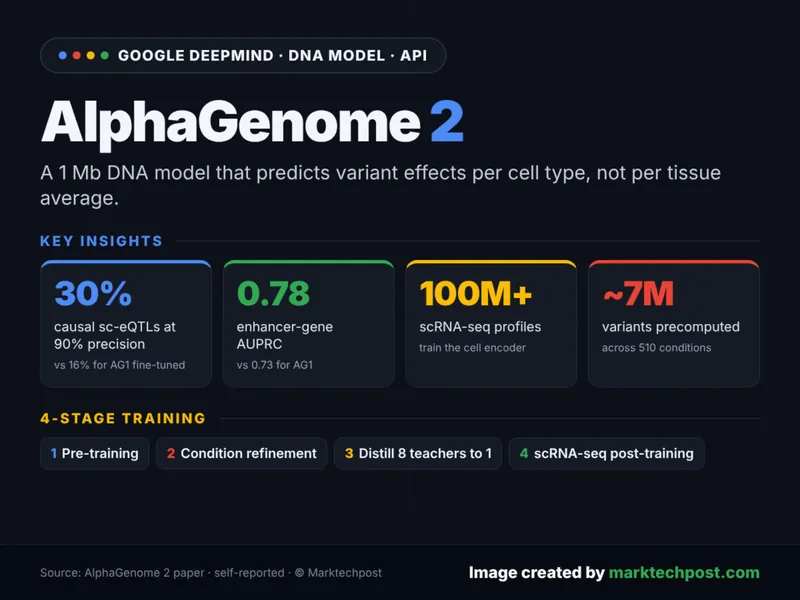
Google DeepMind has launched AlphaGenome 2, a sophisticated AI model designed to predict the effects of DNA mutations in specific cell types. Unlike its predecessor, which averaged predictions across bulk tissue data, this new model can distinguish between closely related cell types and adapt to new single-cell datasets without requiring retraining. It processes a massive one-megabase DNA window, works for both human and mouse genomes, and is currently available as a hosted API for non-commercial research.
The model's ability to condition predictions on cell state—using a 256-dimensional embedding derived from single-cell RNA sequencing data—represents a significant technical leap. This allows researchers to understand how genetic variants might manifest differently in, say, a liver cell versus a kidney cell. While current limitations include restricted access to local model weights and a non-commercial license, AlphaGenome 2 outperforms previous models on key benchmarks, offering a powerful new tool for probing the complex relationship between genetics and cellular function.
Read the original at marktechpost.com
Satirical commentary on real tech news, summarised with AI. Read the original source for the facts. How ZeroDaily works