
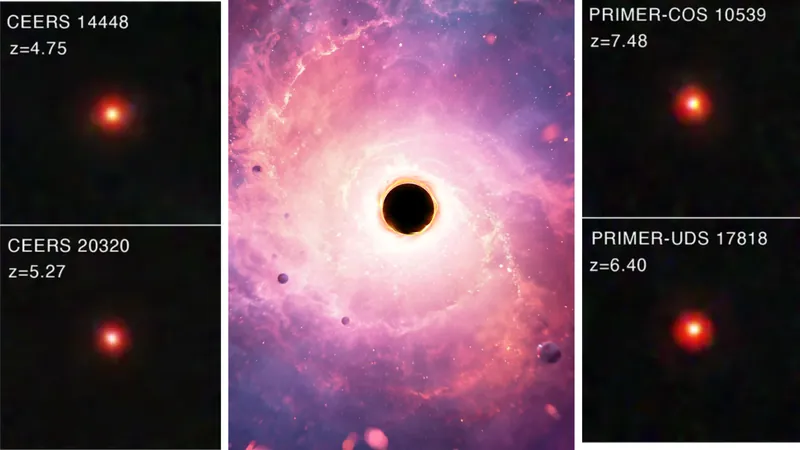
Webb telescope's 'Little Red Dots' might be cosmic fossils from the universe's birth
Original headline: Are the James Webb Space Telescope's mysterious Little Red Dots actually tiny black holes left over from the Big Bang era? — space.com
More in Defense and aerospace news
Astronomers using NASA's James Webb Space Telescope are investigating whether mysterious 'Little Red Dots'—objects that vanished from the early universe—could actually be primordial black holes left over from the Big Bang era. These tiny black holes would have formed not from dead stars but from density fluctuations in the universe's first moments, predating every star and galaxy we see today.
The discovery would fundamentally reshape our understanding of cosmic origins, offering direct evidence for theoretical physics first proposed by Stephen Hawking 50 years ago. For astrophysicists, this means a new tool for probing the universe's earliest conditions, potentially explaining dark matter or revealing new gravitational phenomena. This research transforms JWST from just a telescope into a time machine hunting for the universe's original building blocks.
Read the original at space.com
Satirical commentary on real tech news, summarised with AI. Read the original source for the facts. How ZeroDaily works