
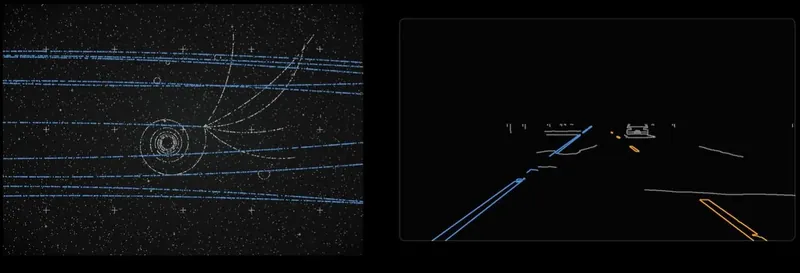
Hough Transforms: The Geometry Trick That Taught Computers How to See Shapes
Original headline: How Hough Transforms Enable Computers to See — hackaday.com
More in Semiconductor and chip news
The article explores how the Hough Transform, a clever algorithm developed in the 1960s for analyzing particle trails in bubble chamber photos, became a fundamental technique in computer vision. It works by detecting lines and shapes in images by transforming pixel data into a mathematical parameter space where patterns become easier to spot, moving far beyond its original physics applications.
For engineers and developers, the Hough Transform represents a bridge between raw visual data and machine understanding—it's why your phone can detect document edges or a self-driving car can identify lane markings. The real challenge isn't just finding lines, but doing it efficiently amidst the noise and complexity of real-world scenes, which led to numerous optimizations. This historical deep-dive reminds us that the 'simple' act of vision requires layers of ingenious mathematics just to replicate a fraction of human perception.
Read the original at hackaday.com
Satirical commentary on real tech news, summarised with AI. Read the original source for the facts. How ZeroDaily works