
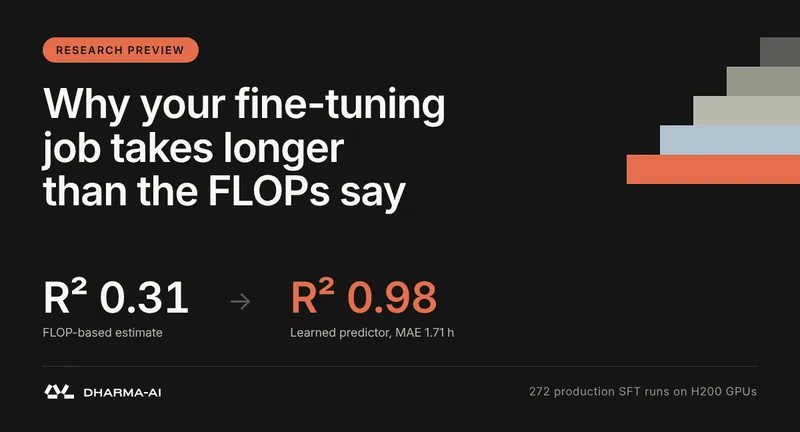
AI's dirty little secret: Your '9-hour' fine-tuning job is probably a 20-hour nightmare
Original headline: Why your fine-tuning job takes longer than the FLOPs say — huggingface.co
More in AI and machine learning news
A new study analyzing 272 real-world fine-tuning jobs on NVIDIA H200 GPUs reveals the shocking inaccuracy of the industry's standard method for predicting how long a job will take. The common 'back-of-the-envelope' calculation, which estimates time based on a model's FLOPs (floating-point operations), performed miserably, explaining only 31% of the actual variation observed, with predictions often off by over 12 hours. This leads to massive inefficiencies in shared GPU clusters, where jobs that finish early leave expensive hardware idle, and jobs that run late create cascading delays for other experiments.
For engineers and teams managing AI infrastructure, this means wasted money, missed deadlines, and inefficient resource allocation. The research shows a better way: a machine learning predictor (CatBoost regressor) that considers real-world factors like evaluation frequency, checkpoint policies, and per-GPU load can achieve near-perfect accuracy (R² = 0.98), cutting prediction errors to under two hours. The key takeaway? Stop guessing and start using smarter, data-driven models to manage your most expensive AI resource.
Read the original at huggingface.co
Satirical commentary on real tech news, summarised with AI. Read the original source for the facts. How ZeroDaily works